
A comprehensive guide for mental health professionals and informed readers exploring the intersection of IFS and psychedelic-assisted therapy.
"The goal of IFS is not to eliminate parts but to restore them to their natural, non-extreme roles by healing the wounds they carry — and to access the Self that can lead them." — Richard C. Schwartz, Internal Family Systems Therapy (2nd ed., 2020)
Introduction: Two Maps of the Mind
Imagine you are standing at the edge of a vast, largely uncharted forest. You know something important lives in there — memories, feelings, patterns you cannot quite reach in ordinary daylight. Now imagine two things: a powerful lantern that floods the forest with light, illuminating what was previously invisible; and a detailed topographic map that lets you navigate the terrain without getting lost.
This is, roughly, what happens when Internal Family Systems (IFS) therapy and psychedelic-assisted therapy (PAT) are brought together. The psychedelic experience — psilocybin, MDMA, ketamine, and others — is the lantern. It floods the interior world with light, loosening the defenses that ordinarily keep certain memories, emotions, and inner voices in the dark. IFS is the map. It gives clinicians and clients a precise, non-pathologizing language for what they find when the light comes on: protective parts running interference, wounded younger selves burdened by old pain, and — at the center of it all — a spacious, compassionate awareness called the Self.
The convergence of these two modalities represents one of the most clinically promising — and conceptually elegant — developments in contemporary psychotherapy. This post explores how they fit together, what the evidence says (and doesn't yet say), and what an IFS-informed psychedelic session actually looks like in practice.
Note: Psychedelic-assisted therapy remains restricted or illegal in many jurisdictions. This post is educational and does not constitute medical or clinical advice. All psychedelic therapy should be conducted under appropriate legal and clinical oversight.
Part I: What is Internal Family Systems?
Developed in the 1980s and '90s by family therapist Richard Schwartz, Internal Family Systems is a model of the mind that treats the psyche as an internal ecosystem — a community of semi-autonomous "parts," each with its own perspective, feelings, memories, and intentions, all organized around a core leadership state called the Self.
The Core Model: Self and Parts
The Self is not a part — it is the ground from which all parts emerge. It is the state you are in when you feel calm, curious, clear, compassionate, connected, courageous, creative, and confident. Schwartz refers to these as the "Eight C's." In healthy functioning, Self leads the system. In psychological distress, parts have taken over leadership — often for very good reasons.
IFS organizes parts into three functional groups:
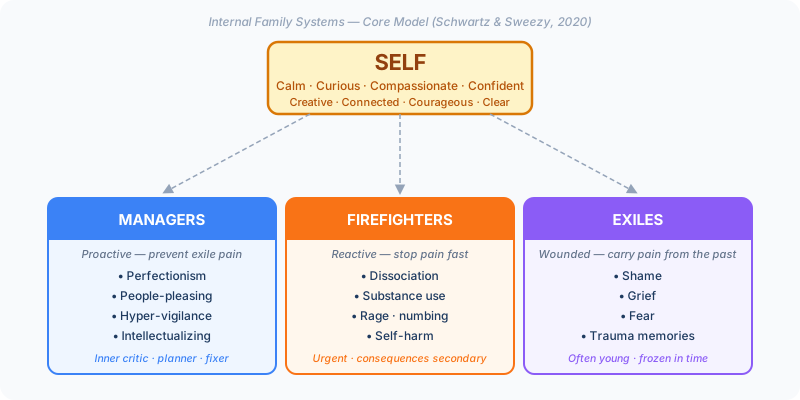
Managers are proactive. They organize your daily life to prevent exile pain from surfacing: staying busy, pleasing others, maintaining control. They are often the most vocal parts in therapy — the inner critic, the planner, the fixer.
Firefighters are reactive. When exile pain breaks through despite managerial efforts, firefighters respond with urgency: alcohol, bingeing, sex, rage, dissociation, suicidal ideation. Their intention is to stop the pain immediately, consequences be damned.
Exiles are the parts most frozen in the past — typically young, carrying burdens of shame, terror, grief, or worthlessness from formative experiences. Managers and firefighters exist largely to protect the system from feeling what the exiles feel.
The Healing Mechanism: Blending, Unblending, and Unburdening
The core process of IFS involves the Self developing relationships with parts — not overriding them, not eliminating them, but genuinely getting to know them. The key clinical moves are:
- Blending: A part merges with Self-consciousness, temporarily taking over. You don't just have an anxious part — you become anxious.
- Unblending: Through curiosity and compassionate inquiry, Self separates from the blended part ("I notice a part of me feels anxious. Can I step back and see it?").
- Witnessing: Self provides attuned, compassionate attention to a part's experience without being swept away.
- Unburdening: Once a part feels truly seen and safe, it can release the beliefs and emotions it has been carrying — often experienced as a profound physical and emotional release.
Key references:
- Schwartz, R.C., & Sweezy, M. (2020). Internal Family Systems Therapy (2nd ed.). Guilford Press.
- Schwartz, R.C. (1995). Internal Family Systems Therapy. Guilford Press.
- Anderson, F.G., Sweezy, M., & Schwartz, R.C. (2017). Internal Family Systems Skills Training Manual. PESI Publishing.
IFS has been applied to trauma, depression, anxiety, eating disorders, chronic pain, and relationship difficulties. While randomized controlled trial (RCT) evidence for IFS is still accumulating compared to CBT or EMDR, pilot studies and clinical reports are promising. A notable study by Shadick et al. (2013) demonstrated IFS-based intervention reduced rheumatoid arthritis pain and improved self-compassion, and emerging trauma-focused IFS research continues to build the evidence base.
Part II: The Psychedelic Research Renaissance
For decades after the 1971 Controlled Substances Act, psychedelic research was essentially frozen. The past twenty years have seen a remarkable thaw, driven by an accumulation of rigorously conducted clinical trials at major academic institutions.
The Research Landscape
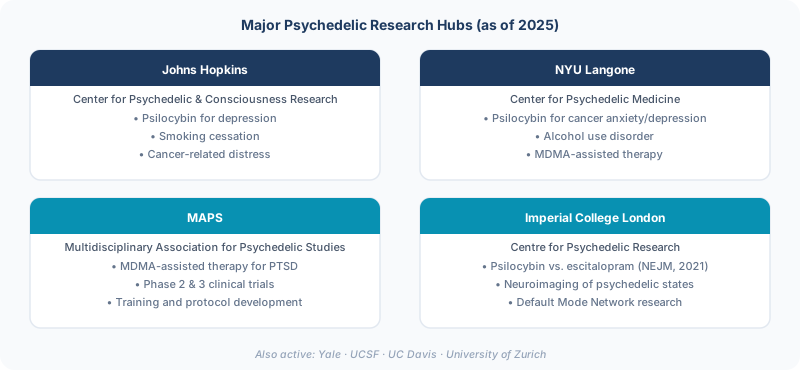
Landmark Studies
The clinical outcomes in peer-reviewed trials have been striking:
Psilocybin for depression:
- Davis, A.K., et al. (2021) found that psilocybin-assisted therapy produced rapid, substantial, and sustained reductions in major depressive disorder symptoms in a Johns Hopkins-affiliated open-label trial. (JAMA Psychiatry)
- Carhart-Harris, R.L., et al. (2021) published a randomized trial in The New England Journal of Medicine comparing psilocybin therapy to the SSRI escitalopram — the psilocybin group showed comparable or superior outcomes across several measures.
Psilocybin for cancer-related distress:
- Griffiths, R.R., et al. (2016) demonstrated that a single high-dose psilocybin session produced substantial and sustained decreases in depression and anxiety in patients with life-threatening cancer. (Journal of Psychopharmacology)
- Ross, S., et al. (2016) reported rapid and sustained symptom reduction in a parallel NYU trial. (Journal of Psychopharmacology)
MDMA for PTSD:
- Mitchell, J.M., et al. (2021) published Phase 3 results showing MDMA-assisted therapy produced large effect sizes for PTSD symptom reduction — 67% of participants no longer met diagnostic criteria for PTSD post-treatment. (Nature Medicine)
What Psychedelics Do, Neurologically
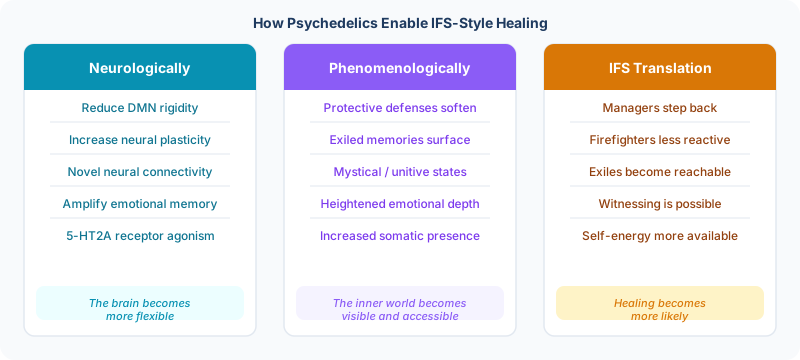
Psychedelics — particularly serotonergic compounds like psilocybin and LSD — act primarily on 5-HT2A receptors. Their most studied neurological effect is a reduction in activity of the Default Mode Network (DMN), a brain network associated with self-referential thinking, rumination, and the rigid maintenance of habitual cognitive patterns.
As journalist and author Michael Pollan described it in How to Change Your Mind (2018): the ordinary mind is like a snow globe — shaken, the snow of daily experience is turbulent; but it always settles back into the same pattern. Psychedelics shake the globe in a way that doesn't allow the snow to settle in exactly the same place. New patterns become possible.
This loosening of rigid mental structures is precisely the neurological substrate that makes psychedelics such a compelling partner for a therapy like IFS — one that specializes in helping people relate differently to their entrenched psychological patterns.
Part III: Why IFS and Psychedelics Belong Together
The conceptual synergy between IFS and psychedelic-assisted therapy is not accidental. They align at multiple levels of theory, phenomenology, and clinical mechanism.
The Phenomenological Overlap
When people describe their psychedelic experiences, they frequently report phenomena that IFS clinicians would immediately recognize:
- "I met a younger version of myself" — classic exile contact
- "A voice kept telling me I wasn't good enough" — a manager or exile with a burdensome belief
- "Something was trying to protect me from going deeper" — a protector negotiation
- "I felt a vast, loving presence that witnessed everything without judgment" — Self-energy
- "I saw all my parts as if from above" — the kind of meta-awareness IFS calls "U-turning"
IFS gives clinicians and clients non-pathologizing language for these experiences. Rather than labeling the critical voice as a symptom or the young frightened figure as a dissociative phenomenon, IFS contextualizes them as parts of a coherent inner system — each with a history, a role, and a potential for healing.
The Therapeutic Alignment
Modern psychedelic therapy manuals — across institutions — emphasize a non-directive, inner-directed approach. Participants are encouraged to "trust, let go, and be open." Guides are trained to support whatever arises without imposing an agenda. This orientation is philosophically identical to IFS's core stance: the Self is the healer, the therapist's job is to help clear the way.
As Mary Cosimano, a longtime guide and research therapist at Johns Hopkins, has described in interviews, the role of the psychedelic guide is not to direct the journey but to hold space — to be a compassionate, regulated presence that allows the participant's own inner wisdom to do the work. This is precisely what IFS calls Self-to-part healing.
Françoise Bourzat, author of Consciousness Medicine (North Atlantic Books, 2019), has spent decades integrating relational, parts-oriented awareness into psychedelic facilitation. She emphasizes that preparation and integration — the before and after — are where the therapeutic relationship most powerfully shapes outcomes. The psychedelic session itself is just one node in a larger relational and developmental process.
The Integration Problem — And IFS's Solution
One of the persistent challenges in psychedelic-assisted therapy is integration: the process of making meaning of the experience and translating insights into lasting behavioral change. This is where IFS is uniquely valuable.
A person may emerge from a psilocybin session having genuinely witnessed a wounded part of themselves with compassion — and then return to daily life where the old managerial and firefighting patterns reassert themselves within days. The managers didn't simply disappear; they stepped aside temporarily and will return. IFS provides a precise vocabulary and methodology for the ongoing work: continuing to build relationships with parts, renegotiating protectors' roles, and gradually supporting exiles in releasing their burdens.
Part IV: Voices at the Intersection
The explicit integration of IFS with psychedelic-assisted therapy is a relatively recent clinical development, but several key figures have contributed to shaping how it looks in practice.
Richard C. Schwartz, PhD — the originator of IFS — has spoken publicly in recent years about the alignment between IFS and psychedelic states. He has noted that many people who have done IFS work report that psychedelic experiences feel "like IFS but with the volume turned way up" — that the parts they have been learning to recognize in session appear vividly and unmistakably during psychedelic states. Schwartz has expressed that IFS preparation may help people navigate psychedelic experiences with greater safety and therapeutic yield.
Françoise Bourzat (author, consciousness educator, longtime practitioner) brings relational, somatic, and inner-parts awareness to psychedelic facilitation — emphasizing that the guide's relationship with their own inner system directly affects the quality of holding space for a client.
Mary Cosimano, MSW (Johns Hopkins) — one of the most experienced psychedelic research therapists in the United States — has shaped the inner-directed, Self-trusting approach that characterizes the Johns Hopkins model and is broadly influential in clinical psychedelic training.
Bessel van der Kolk, MD — author of The Body Keeps the Score and a proponent of both IFS (which he describes in his book) and psychedelic-assisted therapies — represents the convergence of trauma-informed, somatic, and parts-based perspectives with the emerging psychedelic literature.
Part V: An IFS-Informed Psychedelic Session — What It Looks Like
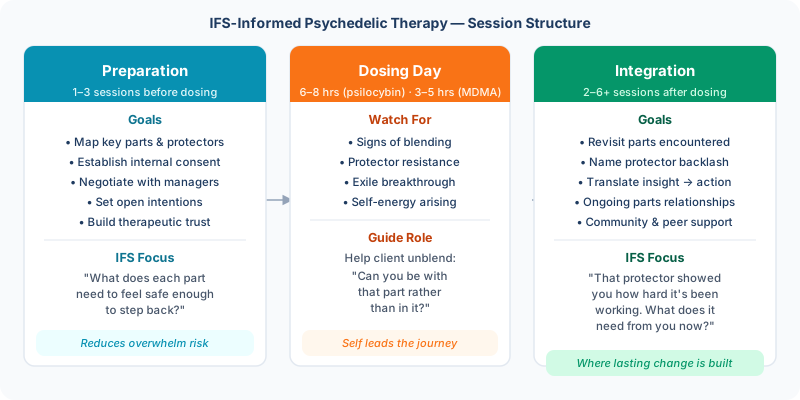
Psychedelic-assisted therapy does not consist of a single drug session. It is a structured process with three phases. IFS principles can be meaningfully integrated into each.
Phase 1: Preparation
In an IFS-informed preparation process, the clinician helps the client develop an initial parts map — identifying the key protective parts (managers and firefighters) that are most active in their system, and the exile experiences these parts are organized around. Crucially, the preparation work asks protectors for their consent and cooperation. This is not manipulation; it is a genuine conversation.
A protector might say: "I don't trust this. I don't know what will happen if I let go." The IFS-informed clinician helps the client acknowledge this concern, get curious about it, and ask the protector what it would need in order to feel safe enough to step back during the session. This pre-negotiation dramatically reduces the likelihood that the journey will be dominated by resistance and overwhelm.
Intentions are set collaboratively — not as demands or expectations of the psychedelic, but as open invitations: "I'm curious to understand what's underneath my depression" rather than "I will heal my depression today."
Phase 2: The Dosing Day
During the session itself — typically lasting 6-8 hours for psilocybin, 3-6 hours for MDMA — the IFS-informed guide monitors for signs of blending: moments when a part has taken over the client's experience and Self is no longer leading.
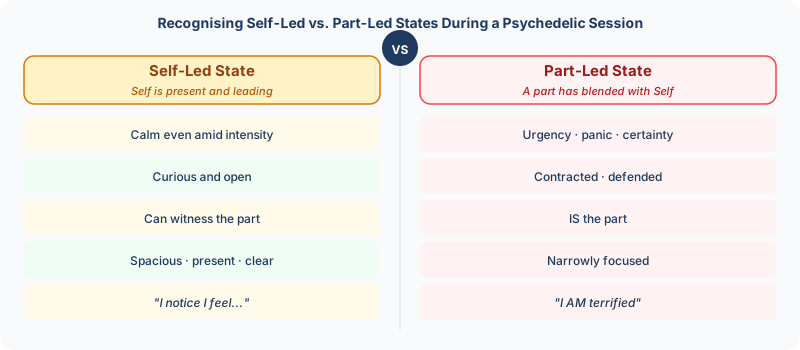
When a client is blended with a part — flooded by terror, overwhelmed by grief, seized by a critical voice — the IFS-informed guide helps them unblend without bypassing. They might say: "Can you be with that part rather than in it? What does it need you to know?" This gentle separation allows the client's Self to return to leadership, transforming the experience from being dominated by a part to witnessing it with compassion.
This skill is particularly valuable in high-intensity moments — the "difficult" passages of a psychedelic journey that some clinical traditions call "challenging experiences." In IFS terms, a challenging experience is often simply a protector that hasn't been sufficiently prepared, or an exile breaking through with more intensity than the system can comfortably metabolize. The guide's job is to help the client stay curious rather than afraid.
Phase 3: Integration
The days and weeks following a dosing session are, many clinicians argue, where the lasting change actually happens or fails to happen. Insights gained during the journey are fragile. They need to be woven into the fabric of daily life — which means relating to the same protective parts that were present before the session.
IFS integration work might include:
- Revisiting parts encountered during the journey: "That protector showed you how hard it's been working. What does it need from you now?"
- Noticing backlash: Protectors often return with increased intensity after an exile experience — a form of the system trying to rebalance. This is normal and predictable, not regression.
- Translating insights into behavior: A person who witnessed their inner child's loneliness may need to make practical changes — setting boundaries, seeking connection, reducing isolation — guided by what their parts communicated.
- Ongoing parts relationships: IFS understands that healing is not a single unburdening event. Parts need ongoing attention, appreciation, and renegotiation.
Part VI: The Evidence — What We Know, What We Don't
Intellectual honesty requires a clear-eyed account of where the evidence stands.
What We Have: Strong Evidence for Psychedelic-Assisted Therapy
The clinical trial literature for PAT is, by the standards of psychotherapy research, unusually robust. Effect sizes for psilocybin in depression and MDMA in PTSD — measured against active controls and comparators — are among the largest seen in mental health treatment research. The durability of outcomes (6-12+ month follow-ups) distinguishes PAT from many pharmacological approaches.
Key meta-analyses and reviews confirm the general trajectory:
- Mithoefer, M.C., et al. (2019). MDMA-assisted psychotherapy for treatment of PTSD: study design and rationale for phase 3 trials based on pooled analysis of six phase 2 randomized controlled trials. Psychopharmacology.
- Palhano-Fontes, F., et al. (2019) demonstrated rapid antidepressant effects of ayahuasca in treatment-resistant depression. Psychological Medicine.
What We Have: Compelling Conceptual Evidence for IFS + Psychedelics
IFS's outcome research, while not yet as extensive as CBT, is growing. Notably:
- Shadick, N.A., et al. (2013). A randomized controlled trial of an IFS-based intervention for rheumatoid arthritis demonstrated significant improvements in self-compassion and pain outcomes. (Journal of Rheumatology)
- IFS is listed as an evidence-based practice for PTSD treatment by the U.S. Department of Veterans Affairs — though the evidence tier is still developing.
Multiple experienced clinicians who use both modalities report that IFS-prepared clients navigate psychedelic sessions with greater ease, greater therapeutic yield, and more coherent integration. These are clinical observations, not RCT data — but they carry meaningful weight.
What We Don't Yet Have
There are currently no large-scale RCTs specifically comparing IFS-informed PAT against non-IFS PAT. The clinical combination is practiced by a growing community of therapists, but the evidence for IFS as the optimal process model for psychedelic work — versus other frameworks like ACT, somatic experiencing, or psychodynamic approaches — is not yet established by controlled research.
This is an honest limitation, not a reason for dismissal. The conceptual alignment is strong, the clinical reports are promising, and the research infrastructure to study this combination more rigorously is now taking shape.
Part VII: Risks, Contraindications, and the Responsibility to Screen
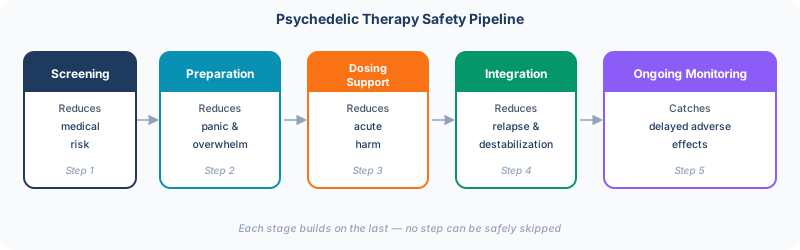
IFS is often described as a gentle modality. Psychedelics are powerful. Together, the stakes of poor screening or inadequate preparation are amplified. This section is not a footnote — it is as clinically essential as any other.
Psychiatric Contraindications
- Personal or family history of psychosis, schizophrenia, or bipolar I disorder: Psychedelics carry real risk of triggering manic or psychotic episodes in vulnerable individuals. This is among the most critical screening criteria.
- Active suicidality: Without sufficient preparation and containment, high-intensity psychedelic states can amplify suicidal ideation.
- Severe dissociative disorders: Psychedelics can increase depersonalization and derealization in individuals already prone to these states.
- Borderline personality disorder: Not an absolute contraindication, but requires exceptional care, preparation, and post-session support.
Medical and Pharmacological Considerations
- Cardiovascular conditions: MDMA has stimulatory cardiovascular effects; psilocybin has modest but real physiological effects. Full cardiac screening is required.
- SSRIs and SNRIs: Can significantly blunt psilocybin effects (requiring dose adjustment considerations); combining with MDMA raises serotonin syndrome risk.
- MAOIs: Dangerous interactions with MDMA; complex interactions with psilocybin. Careful washout periods required.
- Lithium: Contraindicated with psilocybin due to seizure risk.
Psychological and Ethical Risks
- Re-traumatization: Inadequately prepared individuals can experience overwhelm that reinforces rather than heals trauma — particularly if a guide lacks skill in stabilizing blended parts.
- Spiritual bypassing: The mystical dimensions of psychedelic experience can be co-opted by protector parts that use spiritual insight to avoid genuine felt work with exiles.
- Integration failure: Lacking support, the insights of a psychedelic experience can fade within weeks, sometimes replaced by confusion, depression, or a sense of loss.
- Scope-of-practice violations and boundary issues: The intimacy of psychedelic facilitation creates vulnerability. Ethical standards for physical and relational boundaries must be explicit and rigorously upheld.
Part VIII: The Future of IFS and Psychedelic-Assisted Therapy
The convergence of IFS and psychedelic medicine is not a niche interest. As PAT moves toward regulated medical contexts — Oregon legalized supervised psilocybin services in 2023; MDMA-assisted therapy for PTSD has been navigating FDA review — the question of which therapeutic frameworks best guide the work becomes an urgent practical matter.
IFS offers several features that make it particularly well-suited to formalization in psychedelic therapy training:
- A clear session vocabulary: Blending, unblending, protectors, exiles, Self — these terms give facilitators shared language for what they observe and how they respond.
- A non-pathologizing framework: In a clinical environment that increasingly values client autonomy and inner wisdom, IFS's respectful stance toward all parts aligns naturally with the inner-directed ethos of psychedelic work.
- A preparation and integration scaffold: IFS is as useful before and after the session as it is during it — which addresses one of the field's acknowledged gaps.
- A training pathway: IFS-specific training (through the IFS Institute and certified programs) provides a pathway for therapists who want to develop competency in parts-based facilitation.
The important cautions: The spirit of IFS — Self-led, relational, non-directive — can be lost if the model is over-manualized. Psychedelic therapy has already shown the field what happens when protocol and presence diverge. And the field urgently needs more research: controlled studies comparing therapeutic frameworks, training standards for IFS-informed psychedelic facilitation, and longitudinal data on integration outcomes.
There is also the matter of equity. Psychedelic-assisted therapy — as it currently exists — is expensive, legally complex, and not culturally accessible to many of the communities that carry the highest burdens of trauma and mental health need. Any vision of IFS + psychedelics as a transformative mental health intervention must grapple honestly with this.
Conclusion
Something important is happening at the intersection of Internal Family Systems and psychedelic-assisted therapy. Two independently developed modalities — one a comprehensive therapy for healing inner system fragmentation, one a pharmacological approach to unsticking rigid psychological patterns — have discovered that they speak, remarkably, the same language.
Psychedelics open the door. They lower the drawbridge, quiet the guards, and illuminate what has been hidden. IFS provides the map, the relationship skills, and the ongoing practice of meeting what's inside with curiosity and compassion.
The evidence for psychedelic-assisted therapy is, by mental health research standards, striking. The evidence for IFS as the ideal process framework for that therapy is compelling in theory and in clinical experience but still needs controlled research to confirm it. Practitioners working at this intersection are operating on the frontier — which means both the promise and the responsibility are unusually high.
To every part of you that is curious about this, skeptical of it, hopeful, or cautious: all of those responses are welcome. They are parts of a wise and appropriately complex response to genuinely complex territory.
References
IFS — Foundational Texts
Anderson, F.G., Sweezy, M., & Schwartz, R.C. (2017). Internal Family Systems Skills Training Manual. PESI Publishing.
Schwartz, R.C. (1995). Internal Family Systems Therapy. Guilford Press.
Schwartz, R.C., & Sweezy, M. (2020). Internal Family Systems Therapy (2nd ed.). Guilford Press.
Psychedelic-Assisted Therapy — Primary Studies
Reviews and Related Literature
Books
Bourzat, F., & Hunter, K. (2019). Consciousness Medicine: Indigenous Wisdom, Entheogens, and Expanded States of Consciousness for Healing and Growth. North Atlantic Books.
Pollan, M. (2018). How to Change Your Mind: What the New Science of Psychedelics Teaches Us About Consciousness, Dying, Addiction, Depression, and Transcendence. Penguin Press.
van der Kolk, B. (2014). The Body Keeps the Score: Brain, Mind, and Body in the Healing of Trauma. Viking.
This post is for educational purposes only. Psychedelic-assisted therapy should only be pursued within legal frameworks, with properly trained and licensed clinicians, and with comprehensive screening, preparation, and integration support. If you are in crisis, please contact the 988 Suicide and Crisis Lifeline by calling or texting 988.