An evidence-informed exploration of one of psychedelic integration's most complex frontiers
"In a family, no one is ever really lost. They are held in the system, waiting to be seen." — Bert Hellinger, Love's Hidden Symmetry (1998)
"Trauma is not just an event that took place in the past. It is also the imprint left by that experience on mind, brain, and body." — Bessel van der Kolk, The Body Keeps the Score (2014)
Introduction: When the Ancestors Appear
During a psilocybin-assisted therapy session, a 42-year-old woman — call her Elena — found herself not alone in the room. The dissolution of ordinary ego-boundaries had been gradual, and then sudden. In the space that opened, she encountered figures she recognized without explanation: a grandmother who had survived a wartime displacement she never spoke of, and behind her, someone older still, a woman she had never met but somehow knew. Elena wept for losses she had not personally experienced. She received a wordless transmission: you are allowed to live freely. When the session ended, something in her had shifted — a loyalty she had carried without knowing its name.
Experiences like Elena's are reported with striking frequency in psychedelic-assisted therapy. Participants encounter ancestors, feel the weight of collective or family suffering, and sometimes report a sense of resolution that extends beyond their individual biography. Clinicians working at this intersection have turned, increasingly, to Family Constellation Therapy (FCT) — also called Systemic Constellation Work — as one possible framework for understanding and integrating these experiences.
This post explores that intersection carefully: what FCT offers, where its evidence base stands, where Bert Hellinger's method went wrong, and how therapists can draw on systemic principles without importing the method's significant risks. Throughout, we will distinguish between what the science supports, what is clinically plausible but unproven, and what belongs to the realm of phenomenological metaphor.
A note on epistemic honesty: Family Constellation Therapy occupies genuinely contested ground. It has produced meaningful clinical experiences for many people and genuine harm for others. Psychedelic states amplify suggestibility. The combination demands sober, careful handling.
1. What is Family Constellation Therapy?
Origins and Core Framework
Family Constellation Therapy was developed by the German psychotherapist Bert Hellinger (1925–2019) in the 1980s and 1990s, synthesizing influences from Virginia Satir's family sculpture work, Jacob Moreno's psychodrama, indigenous Zulu healing practices Hellinger encountered as a missionary, and existential philosophy (Hellinger, 1998; Ulsamer, 2003).
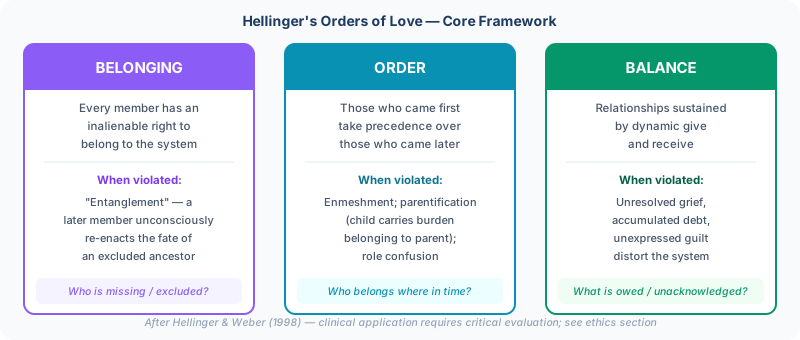
The method rests on three core principles Hellinger called the Orders of Love:
1. Belonging: Every member of a family system has an inalienable right to belong. When a person is excluded — the child who died, the relative who was murdered, the ancestor who was sent away in shame — the system carries a disturbance. A later family member may unconsciously "represent" or re-enact the fate of the excluded one, experiencing their suffering as their own.
2. Order (Hierarchy of Time): Those who came first in a family system take precedence over those who came later. When this order is violated — when a child tries to carry burdens belonging to a parent, or when a parent treats a child as a partner substitute — suffering follows.
3. Balance (Give and Take): Relationships are maintained by a dynamic balance between giving and receiving. Where debt, guilt, or unexpressed grief accumulates unresolved, it distorts the system.
What Happens in a Constellation
In its group format, a facilitator asks a client (the "issue-holder") to identify their presenting concern — depression, relationship patterns, physical symptoms, life stagnation. The client then selects group members to represent family figures and places them in space in the room according to intuition. What happens next is, from a phenomenological standpoint, striking: the representatives often report physical sensations, emotions, and impulses that seem to correspond to the figures they represent — a phenomenon Hellinger termed the "knowing field" (wissendes Feld).
The facilitator works with these movements and statements to reveal hidden loyalties, excluded members, or systemic entanglements, ultimately guiding toward "movements of the soul" — spontaneous gestures of acknowledgment, mourning, or release that can produce shifts in the issue-holder.
An individual version, using floor anchors or small figures on a table rather than live representatives, has also become widely practiced, including in therapeutic (rather than group seminar) settings.
The "Knowing Field": Phenomenon Without Established Mechanism
The knowing field is the most contested element of constellation work. Hellinger and some of his followers attributed it to morphic resonance — Rupert Sheldrake's hypothesis that biological forms and behaviors are shaped by immaterial "morphic fields" that can transmit information across space and time (Sheldrake, 1981/2009). This hypothesis has not achieved scientific consensus and remains outside mainstream physics and biology.
More parsimonious explanations for representative experiences include: ideomotor responding (unconscious physical responses to contextual cues), social perception (picking up on microexpressions and spatial positioning), and priming effects (the facilitator's framing shaping what representatives experience) (Bürgi, 2017).
The clinical takeaway is that the phenomenon of representatives reporting resonant experiences is real — but the mechanism is unknown and the morphic field explanation should be treated as an unverified hypothesis, not established science.
2. The Hellinger Problem: A Necessary Reckoning
Any discussion of Family Constellation Therapy that does not address Bert Hellinger's later years is incomplete and, frankly, irresponsible for clinical use.
In his early work, Hellinger produced genuinely useful frameworks for thinking about family systems and intergenerational dynamics. His later career was marred by a series of documented harms:
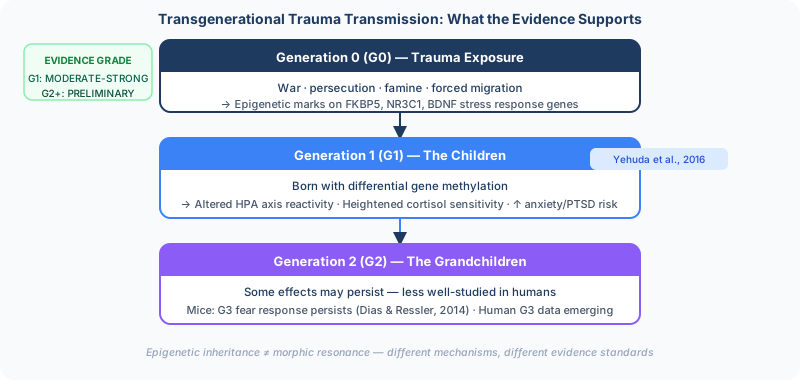
- Gendered prescriptions: Hellinger made categorical pronouncements that women "naturally" subordinate to men in healthy family systems, and that homosexuality represented a systemic entanglement (Hellinger, 2001). These positions are not supported by empirical research and caused direct harm to clients, particularly LGBTQ+ individuals.
- Cult-of-personality facilitation: Hellinger increasingly worked in large-scale seminar formats where he would make rapid, authoritative pronouncements ("the system says...") with minimal psychological safety. Critics documented clients being told to "accept" abusive family members, suicide being framed as "following fate," and Holocaust experiences being "resolved" in ways survivors' descendants found retraumatizing (Cohen, 2006; Hausner, 2011).
- Closed epistemic system: Late-period Hellinger claimed direct access to systemic truth that brooked no challenge. This is precisely the authority structure that becomes dangerous when amplified by psychedelic suggestibility.
The reform movement: A substantial portion of the constellation therapy community has explicitly distanced itself from Hellinger's later positions. Practitioners like Stephan Hausner, Ursula Franke, and groups like the INFOSYON international federation have developed ethical frameworks, supervision standards, and content guidelines that explicitly reject Hellinger's gender and sexuality pronouncements (INFOSYON, 2018). This reformed practice is meaningfully different from Hellinger's seminar-style work.
3. The Science of Transgenerational Transmission
Beneath the contested phenomenology of constellation work lies a legitimate and growing body of neuroscientific and epigenetic research on transgenerational trauma transmission. This is the empirical foundation on which responsible integration of systemic approaches can stand.
Epigenetics and Inherited Trauma
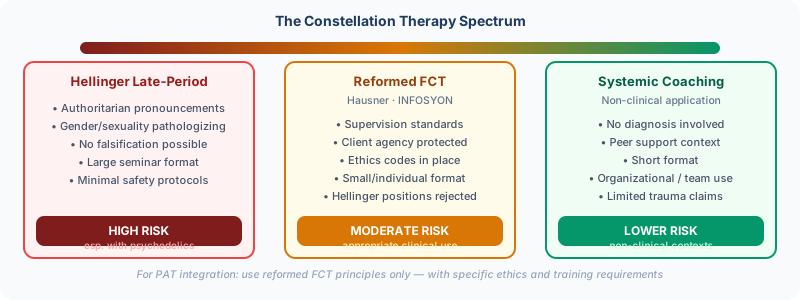
Rachel Yehuda and colleagues at the Icahn School of Medicine at Mount Sinai have produced some of the most rigorous evidence for biological transgenerational trauma effects. In a landmark 2016 study, Yehuda et al. examined Holocaust survivors and their adult offspring, finding differential methylation of the FKBP5 gene — a key regulator of stress hormone (cortisol) sensitivity — in both parents and children, with a pattern consistent with epigenetic inheritance rather than shared environmental exposure (Yehuda et al., 2016).
This is significant: it suggests that trauma leaves biological marks that can be transmitted to subsequent generations through epigenetic mechanisms — alterations in gene expression that do not change the DNA sequence itself but affect how genes are read.
Brian Dias and Kerry Ressler at Emory University demonstrated a related phenomenon in mice: animals trained to fear a specific cherry blossom scent passed that fear response — along with corresponding neurological and morphological changes in olfactory sensory neurons — to their offspring and grandchildren, without those descendants ever encountering the original conditioned stimulus (Dias & Ressler, 2014).
Martin Teicher and colleagues at Harvard have documented structural brain differences — including alterations in hippocampal volume and prefrontal-limbic connectivity — in children of trauma survivors, consistent with epigenetic transmission of stress-response dysregulation (Teicher & Samson, 2016).
What the Science Does NOT Support
- Morphic resonance as mechanism for constellation phenomena: Sheldrake's hypothesis has not been experimentally validated and is not accepted by mainstream biology or physics (Sheldrake, 2009; but see peer critique: Pigliucci & Boudry, 2013).
- "Systemic knowing" as a paranormal channel: The accuracy of representative experiences in constellations has not been validated in controlled conditions against chance performance.
- Specific ancestral memories being accessed in psychedelic states: While participants report ancestral encounters, these are more parsimoniously explained as the psyche's symbolic use of transgenerational themes, not literal ancestral communication.
The distinction matters clinically. Grounding the conversation in Yehuda's epigenetics gives clients a genuine, research-supported model. Invoking morphic fields as established fact misleads them.
4. Why Psychedelics and Systemic Work Resonate
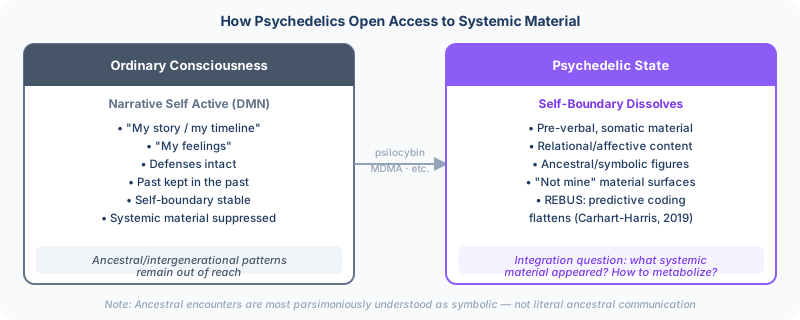
The Ego Dissolution → System Opening Shift
A central finding in psychedelic neuroscience is that classic psychedelics — psilocybin, LSD, ayahuasca, MDMA — reliably reduce default mode network (DMN) activity and loosen the narrative self-model that ordinarily organizes experience (Carhart-Harris et al., 2012; Lebedev et al., 2015).
This has a specific implication for systemic work: the ordinary sense of "where I end and others begin" relaxes. The psyche, freed from its habitual self-referential frame, appears to have greater access to material that is:
- Pre-verbal and somatic (consistent with early relational trauma)
- Relational and affective (sensations that feel like "not mine," belonging to others in one's lineage)
- Symbolic and archetypal (ancestral figures as psyche's own symbolic representation of inherited patterns)
The REBUS (Relaxed Beliefs Under Psychedelics) model proposed by Carhart-Harris and Friston (2019) offers a neuroscientific framework: psychedelics flatten hierarchical predictive coding, temporarily overriding the top-down beliefs that normally suppress bottom-up sensory and emotional signals. This may explain why material that has been suppressed — including grief, loyalty binds, and relational patterns encoded in early development — surfaces in psychedelic states.
What Participants Report
Analyses of narrative accounts from psychedelic-assisted therapy sessions document recurring themes consistent with systemic/constellation frameworks:
- Encounters with ancestors: Participants report sensing the presence of deceased relatives, receiving wordless communications, or seeing their lineage as a visual field (Richards, 2015; Grof, 2010).
- Intergenerational grief: Participants describe weeping for losses they did not personally experience, or feeling grief that seems too large for their own life — a description consistent with Yehuda's concept of "transmitted trauma" (Yehuda, 2002).
- Resolution of inherited loyalty binds: Some report a felt sense of release from patterns they recognize, in retrospect, as belonging to an earlier generation — patterns of sacrifice, self-diminishment, or exclusion.
- Systemic sentences: The kind of spontaneous vocalizations that happen in constellations — "I see you," "I carry this for you," "I give this back to you" — arise organically in psychedelic states even for participants with no constellation exposure.
These reports do not constitute evidence that ancestral communication is literally occurring. They do suggest that the psyche, in psychedelic states, organizes itself around systemic and relational themes that constellation work has developed rich clinical tools to address.
5. Key Practitioners at the Intersection
Several therapists and researchers have worked thoughtfully to integrate systemic approaches into psychedelic-assisted therapy. We note where each has contributed and where their work remains to be evaluated empirically.
Stephan Hausner
A Munich-based family therapist and one of the most clinically rigorous voices in constellation work, Hausner has explicitly developed "constellation work for illness" and integrated epigenetic understanding into his practice. He has been a leading voice in reforming constellation ethics and separating the method from Hellinger's later authoritarian style. His book Even If It Costs Me My Life (2011) is essential reading for anyone integrating systemic approaches with health concerns. While not working explicitly with psychedelics, his clinical frameworks are directly applicable.
Thomas Hübl
A teacher and facilitator who works in the intersection of trauma, collective healing, and systemic approaches. Hübl's framework, described in Healing Collective Trauma (2020), draws on neuroscience, constellation work, and contemplative traditions. He has addressed "collective trauma constellations" with rigor and has developed protocols that explicitly address facilitator ethics. Like Hausner, he does not work with psychedelics directly but his integration frameworks are clinically relevant.
Françoise Bourzat
A psychedelic facilitator and author of Consciousness Medicine (2019), Bourzat has worked with expanded states for over 30 years and integrates systemic elements — particularly ancestral encounters and intergenerational healing — into her approach. Her book provides practical integration frameworks. She addresses ancestral material through a "spiritual ecology" lens; readers should note that some of this framework extends beyond what current evidence supports, though her clinical experience is substantial.
Daniel Foor
Author of Ancestral Medicine (2017), Foor works at the intersection of animist traditions and contemporary therapy. While not a psychedelic clinician, his framework for "working well with the ancestors" has influenced how many integration therapists approach ancestral themes. His approach to distinguishing between "well ancestors" (those who have processed their suffering) and "unwell ancestors" (those still carrying unresolved trauma) offers a clinically useful metaphorical framework — particularly for clients who encounter multiple ancestral figures in psychedelic states.
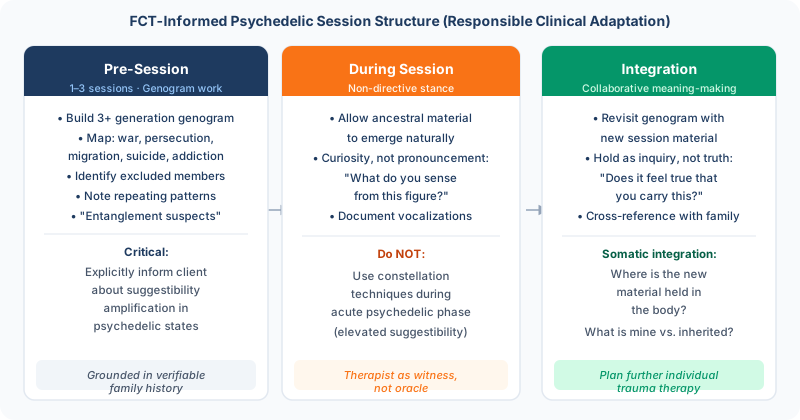
6. Session Structure: A Responsible Integration Framework
The following structure reflects a cautious, clinician-supervised approach — not a constellation group seminar, but an informed adaptation for individual psychedelic integration therapy.
The Genogram as Preparation Tool
The genogram — a structured multi-generational family map — is one of the most valuable and evidence-supported tools from the family therapy tradition (McGoldrick, Gerson & Petry, 2008). Unlike constellation work's more phenomenological approaches, genogram construction is grounded, collaborative, and anchors systemic exploration in verifiable history.
Preparing a genogram before a psychedelic session serves multiple functions:
- It primes the client to notice relational and ancestral material without prescribing what they will find
- It provides a reference document for integration work
- It grounds any ancestral encounters in what is factually known, helping distinguish between genuinely historical figures and purely symbolic representations
7. Evidence Gradient
It is essential to be honest about where the evidence stands. The following framework is adapted from the consensus synthesis underlying this post:
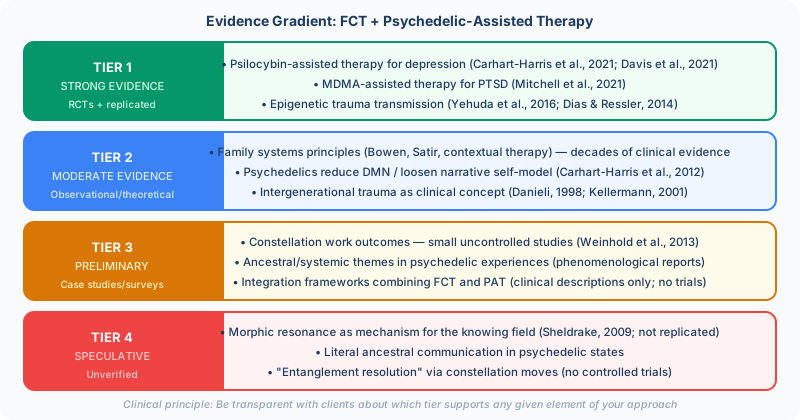
Clinical principle: Clinicians should be transparent with clients about which tier of evidence supports any given element of their approach. Conflating Tier 1 and Tier 4 is both epistemically dishonest and potentially harmful, particularly in psychedelic contexts where clients may be especially open to suggestion.
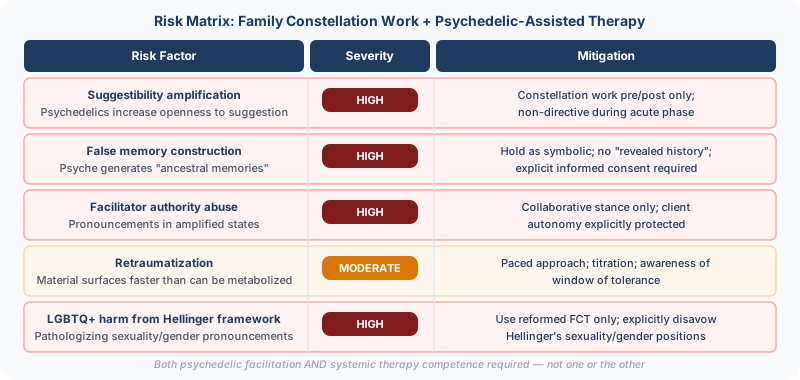
8. Risks and Contraindications: This Section Cannot Be a Footnote
In most contexts, the risks of a therapeutic modality occupy a brief cautionary paragraph. In the context of family constellation therapy combined with psychedelic-assisted therapy, risks demand substantially more than that — because the combination creates a specific, underappreciated danger profile.
8.1 Psychedelic Suggestibility Amplification
Classic psychedelics and MDMA significantly increase suggestibility — defined as the tendency to accept and internalize suggestions from the environment, including from authority figures (Carhart-Harris et al., 2018). In a well-designed psychedelic-assisted therapy protocol, this is managed through careful therapist training, non-directive stance during acute phases, and explicit protocols against therapist self-disclosure and interpretation.
In combination with a constellation framework — particularly one delivered in a charismatic, seminar-style format — amplified suggestibility creates serious risk. A facilitator's pronouncement that "the system says your mother's suicide was her way of following her own mother's fate" can be experienced with all the phenomenological weight of direct revelation. Clients may be unable, in that state, to critically evaluate the claim.
Mitigation: Constellation-informed integration work should proceed primarily in non-acute states (pre- and post-session). Direct constellation interventions during psychedelic sessions should be avoided unless the therapist has specific training in both modalities and explicit informed consent addressing this risk.
8.2 False Memory and Confabulation
Psychedelic states produce intense narrative and symbolic processing. The psyche generates stories. Combined with a framework that posits hidden ancestral patterns as explanations for present symptoms, there is a meaningful risk that clients will construct false memories — "memories" of ancestral experiences that feel absolutely real but are generated by the psyche's pattern-completion in a suggestible state.
This is not hypothetical: the history of psychotherapy includes well-documented "recovered memory" crises (Loftus & Ketcham, 1994). The specific concern with constellation work is that the framework provides an attractive, emotionally resonant story structure that the psychedelic-primed psyche can fill in with synthetic content.
Mitigation: Therapists should explicitly inform clients that ancestral encounters in psychedelic states are treated as symbolic and psychologically meaningful — not as literally accurate historical records. Any family history "revealed" in a session should be held lightly and, where possible, cross-referenced with actual family records or conversations with living relatives.
8.3 The Authority Structure Risk
Traditional Hellinger-style constellations operate through a specific authority structure: the facilitator has access to systemic truth that the client does not. When a constellation facilitator says, "Your body says this is right," or "The system is showing us that your grandmother needs you to mourn her," they are making pronouncements that bypass client agency.
Combined with psychedelics, this structure becomes particularly dangerous:
- The client is in a state of diminished critical faculty
- The facilitator's words carry unusual weight
- The emotional intensity of the experience can produce the illusion of insight where there is actually implanted suggestion
Mitigation: All integration work using systemic frameworks should use collaborative, questioning language rather than authoritative pronouncements. Therapists must be trained in trauma-informed facilitation and the specific ethics of psychedelic-assisted work. Group formats combining psychedelics and constellation work should be treated with extreme caution until formal safety and ethics guidelines have been developed.
8.4 Retraumatization and Spiritual Bypassing
Constellation work — particularly when it focuses on ancestral trauma without adequate grounding in the client's own nervous system regulation — can access material faster than a client can metabolize it. In psychedelic states, this risk is amplified.
The specific spiritual bypassing risk in FCT-psychedelic integration: the framework's emphasis on systemic resolution ("the entanglement is resolved") can be used — consciously or unconsciously — to bypass the slow, difficult work of individual therapy. A client can have a dramatic ancestral resolution experience in a psychedelic constellation session and leave feeling "healed" while the underlying trauma remains neurologically encoded and behaviorally active.
Mitigation: Constellation-informed work should be understood as one tool within a comprehensive treatment plan, not a single-session cure. Integration therapy after any systemic psychedelic experience should explicitly include individual trauma processing work.
Contraindications
FCT-informed psychedelic integration is not appropriate when:
- The client has untreated or poorly stabilized dissociative symptoms
- The client is in an acute grief or bereavement state without adequate support
- The client has a personal or family history of psychosis
- The treating clinician has training in psychedelic-assisted therapy but not in systemic/family therapy (or vice versa) — both competencies are required
- The proposed setting is a group constellation seminar format without individual clinical oversight
9. The Conceptual Bridge: What FCT Offers That Other Frameworks Don't
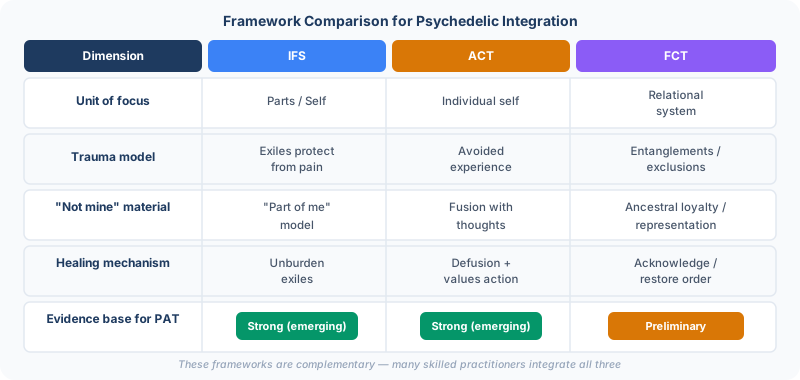
Setting aside the risks, why consider FCT-informed integration at all? Because several phenomena that arise in psychedelic-assisted therapy are addressed more directly by systemic frameworks than by individual-focused therapies:
Experiences that seem "not mine": IFS offers "parts" to explain ego-syntonic vs. ego-alien material, but when what arises in a session feels specifically like it belongs to another person — a parent, an ancestor — FCT's vocabulary of "entanglement" and "representation" offers a more precise framework.
Grief for losses not personally experienced: Collective and ancestral grief is a documented phenomenon in clinical work with descendants of trauma (Danieli, 1998; Kellermann, 2001). Individual-focused therapies can struggle to metabolize grief that has no first-person referent. Systemic approaches name and normalize this experience.
Repeating patterns across generations: When a client recognizes a pattern — depression, suicide attempts, abandonment, substance use — recurring across multiple generations, a systemic lens can be more activating and illuminating than an individual one. This is not because systemic entanglement is the only or proven explanation, but because the systemic frame helps clients see beyond individual deficiency narratives.
Resolution as relationship, not just insight: Individual therapies typically aim at insight, behavior change, or nervous system regulation. Constellation work proposes that healing involves the relational system — acknowledging excluded members, restoring order, allowing grief to move. Whether or not the metaphysics of the "field" are accurate, the relational-acknowledgment model has clinical resonance that many clients find more complete than individual insight alone.
10. A Clinical Illustration (Composite, Anonymized)
Rafael, a 55-year-old Mexican-American man, presented for psilocybin-assisted therapy with treatment-resistant depression and a presenting complaint he described as "inherited sadness — it's not mine, I've always known it's not mine."
Pre-session genogram work revealed a grandfather who had been forcibly displaced from his village during the Cristero War in the 1920s, a death he had never spoken of — a brother who did not survive the journey. This excluded figure had never been acknowledged within the family.
During his psilocybin session, Rafael encountered a figure he did not consciously recognize — a young man, wordless, standing at what felt like a threshold. He did not receive a "message." He simply sat with the figure until grief moved through him. Afterward he said: "I think I cried for him. I don't know who he was, but I cried for him."
In integration sessions, the therapist — who had prepared the genogram with Rafael — held the experience carefully. They did not pronounce that this was the excluded great-uncle. They asked: "What does it mean to you that this figure appeared? What would it mean if the sadness you've carried had roots in something older than your own life?" They used the genogram to explore what might be known about the missing generation. Rafael wrote a letter — to no one, to everyone — acknowledging a loss in his lineage that had never been named.
At six-month follow-up, his depression scores had improved substantially. He did not attribute this to ancestral contact. He attributed it to "finally being allowed to grieve something I didn't know I was grieving."
This case illustrates the appropriate use of systemic principles in psychedelic integration: generative, collaborative, humble about mechanism, and grounded in what is actually known.
11. Future Directions
Family constellation therapy sits at the most empirically contested edge of psychedelic integration work. Yet the phenomena it addresses — ancestral grief, intergenerational trauma, systemic loyalty — are documented in both clinical reports and emerging neuroscience. Several directions would substantially advance the field:
Research priorities:
- Phenomenological studies of ancestral/systemic themes in psychedelic-assisted therapy sessions (qualitative, first step)
- Feasibility studies of structured genogram preparation + individual constellation-informed integration in PAT contexts
- Comparison of integration modalities (IFS, ACT, FCT-informed, standard) for ancestral-content psychedelic experiences
- Controlled studies of epigenetic markers in descendants of trauma survivors before and after PAT
Clinical development priorities:
- Ethical guidelines for practitioners integrating constellation work and psychedelic-assisted therapy (adapted from INFOSYON standards)
- Training requirements: clinicians should hold competence in BOTH psychedelic facilitation AND systemic/family therapy before integrating approaches
- Clear protocols for managing suggestibility amplification and authority structure risks
- Community of practice development separating reformed constellation work from Hellinger-style seminar formats
Theoretical development:
- More rigorous phenomenological mapping of the "knowing field" phenomenon — investigating social perception, ideomotor, and attentional mechanisms before invoking non-local explanations
- Integration of polyvagal theory (Porges, 2011) with systemic understanding of inherited trauma embodiment
- Collaborative work between epigenetics researchers (Yehuda, Ressler) and psychedelic neuroscientists (Carhart-Harris, Griffiths) on trauma transmission and psychedelic reset mechanisms
Conclusion: The Ancestors as Metaphor, the Body as Evidence
Family Constellation Therapy, at its best, offers something rare in the therapeutic landscape: a framework for metabolizing experiences that feel larger than the individual — grief that belongs to lineages, patterns that predate personal memory, loyalties that bind without the binder's awareness.
Psychedelic-assisted therapy, at its best, creates the conditions in which exactly this kind of material surfaces and becomes available for healing.
The combination is neither a miracle nor a minefield — it is a frontier requiring both genuine openness and genuine rigor. The epigenetic science of Yehuda and Ressler gives us empirical ground to stand on: transgenerational trauma transmission is real, biological, and potentially reversible. The phenomenological reports from thousands of psychedelic sessions give us clinical ground to stand on: ancestral and systemic themes arise, reliably, and demand integration.
What we do not have is adequate evidence that constellation mechanics — the specific techniques, the "knowing field," the systemic sentences — produce the healing rather than simply naming it. We do not have evidence that Hellinger's Orders of Love are universal truths rather than culturally contingent intuitions. We do not have evidence that morphic fields transmit ancestral information rather than individual nervous systems generating ancestral images from inherited biological information.
These distinctions are not pedantry. They are the difference between a clinician who helps a client integrate an ancestral encounter with grace and intellectual honesty, and a facilitator who tells a client, in an amplified-suggestibility state, what their ancestor needs them to do.
The ancestors, if they speak to us at all, deserve better than that.
Key Researchers and Practitioners
| Name | Contribution | Key Work |
|---|---|---|
| Bert Hellinger | Developed family constellation method; later work controversial | Love's Hidden Symmetry (1998) |
| Stephan Hausner | Reformed constellation ethics; illness and trauma focus | Even If It Costs Me My Life (2011) |
| Thomas Hübl | Collective trauma healing; systemic and contemplative integration | Healing Collective Trauma (2020) |
| Françoise Bourzat | Psychedelic facilitation with systemic/ancestral elements | Consciousness Medicine (2019) |
| Daniel Foor | Ancestral healing frameworks | Ancestral Medicine (2017) |
| Rachel Yehuda | Epigenetic transmission of trauma (FKBP5, Holocaust research) | Yehuda et al. (2016) |
| Brian Dias & Kerry Ressler | Transgenerational fear conditioning in mice | Dias & Ressler (2014) |
| Robin Carhart-Harris | Psychedelic neuroscience; REBUS model; DMN research | Carhart-Harris et al. (2012, 2019) |
| Rupert Sheldrake | Morphic resonance hypothesis (cited as unverified) | Morphic Resonance (2009) |
References
A-Tjak, J. G. L., Davis, M. L., Morina, N., Powers, M. B., Smits, J. A. J., & Emmelkamp, P. M. G. (2015). A meta-analysis of the efficacy of acceptance and commitment therapy for clinically relevant mental and physical health problems. Psychotherapy and Psychosomatics, 84(1), 30–36.
Bourzat, F., & Hunter, K. (2019). Consciousness medicine: Indigenous wisdom, entheogens, and expanded states of consciousness for healing and growth. North Atlantic Books.
Cohen, B. B. (2006). Reclaiming our roots: Decolonizing family constellations. The Knowing Field, 7, 20–24.
Danieli, Y. (Ed.). (1998). International handbook of multigenerational legacies of trauma. Plenum Press.
Foor, D. (2017). Ancestral medicine: Rituals for personal and family healing. Bear & Company.
Grof, S. (2010). Holotropic breathwork: A new approach to self-exploration and therapy. SUNY Press.
Hausner, S. (2011). Even if it costs me my life: Systemic constellations and serious illness. Gestalt Press.
Hellinger, B., Weber, G., & Beaumont, H. (1998). Love's hidden symmetry: What makes love work in relationships. Zeig, Tucker & Theisen.
Hübl, T., & Avritt, J. J. (2020). Healing collective trauma: A process for integrating our intergenerational and cultural wounds. Sounds True.
INFOSYON. (2018). Ethics guidelines for systemic constellation work. International Association for Systemic Constellations Work. Retrieved from www.infosyon.com.
Loftus, E., & Ketcham, K. (1994). The myth of repressed memory: False memories and allegations of sexual abuse. St. Martin's Press.
McGoldrick, M., Gerson, R., & Petry, S. (2008). Genograms: Assessment and intervention (3rd ed.). W. W. Norton.
Pigliucci, M., & Boudry, M. (Eds.). (2013). Philosophy of pseudoscience: Reconsidering the demarcation problem. University of Chicago Press.
Porges, S. W. (2011). The polyvagal theory: Neurophysiological foundations of emotions, attachment, communication, and self-regulation. W. W. Norton.
Richards, W. A. (2015). Sacred knowledge: Psychedelics and religious experiences. Columbia University Press.
Sheldrake, R. (2009). Morphic resonance: The nature of formative causation (4th ed.). Park Street Press. (Originally published 1981 as A new science of life)
Ulsamer, B. (2003). The healing power of the past: A new approach to healing family wounds. Ulysses Press.
Yehuda, R. (2002). Post-traumatic stress disorder. New England Journal of Medicine, 346(2), 108–114.
van der Kolk, B. A. (2014). The body keeps the score: Brain, mind, and body in the healing of trauma. Viking.
This post is intended for clinicians, researchers, and informed general readers interested in the intersection of systemic therapeutic approaches and psychedelic-assisted therapy. Nothing in this post constitutes clinical advice. Psychedelic-assisted therapy should be pursued only under the supervision of licensed, trained clinicians in appropriate legal contexts.
Evidence classifications in this post are based on the author's synthesis of available literature and are offered as clinical guidance, not as formal systematic review findings. The field is evolving rapidly; readers are encouraged to consult primary sources and updated literature.